
Book a Falcon 100
Falcon 100
Super midsize jet
The Falcon 100 is the modernized successor to the Falcon 10, bringing EFIS glass cockpits (a civil aviation first) and external baggage access. It pairs fighter-jet agility and speed with a safer, upgraded flight deck and increased payload capacity.
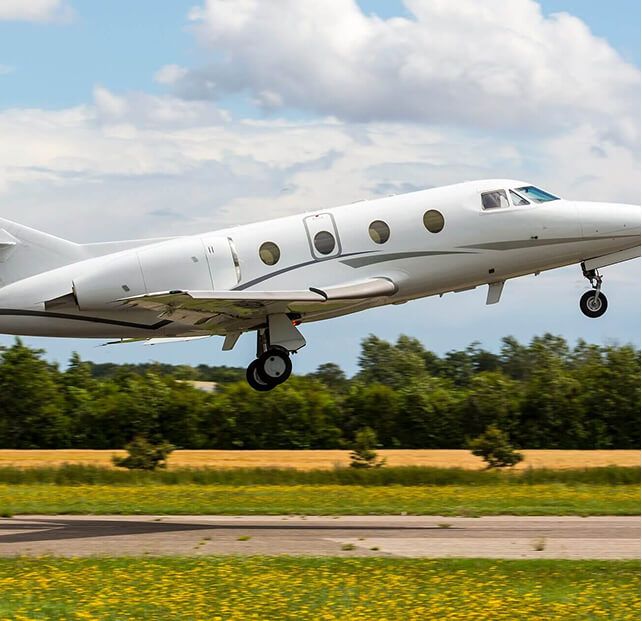
A Technological First for Falcon
Overview
The Dassault Falcon 100 was introduced in 1983 as the modernized continuation of the high-performance Falcon 10. While retaining the speed (Mach 0.86), agility, and robust structure derived from Dassault’s military fighter jet expertise, the Falcon 100’s purpose was to bring crucial technological and logistical upgrades to the light jet segment, setting a new standard for operational safety and utility.
The Falcon 100’s significance is marked by three primary enhancements over its predecessor. It became the first certified business aircraft to offer an Electronic Flight Instrument System (EFIS) with color screens in its cockpit. This revolutionary digital display system vastly improved pilot situational awareness, navigation precision, and flight safety. Furthermore, the aircraft received an increased Maximum Takeoff Weight (MTOW) and a critical structural change to improve utility: the addition of a larger, external rear baggage compartment for improved accessibility and total cargo volume. Subtle changes included the addition of an extra cabin window (often on the starboard side), enhancing natural light and the sense of space within the compact executive cabin. By blending its legendary speed and agility with first-generation glass cockpit technology, the Falcon 100 delivered a highly capable, safer, and modernized platform for demanding mid-range executive travel.
High-Speed Comfort with Enhanced Light
Luxury interior
The Falcon 100's interior prioritizes sophisticated executive travel, retaining the high-quality French design of its predecessor. Its compact cabin features plush club seating and an enclosed lavatory. The major refinement is an enhanced focus on passenger comfort, achieved through better lighting and improved utility systems.
Brighter, Airy Cabin Design
The Falcon 100 introduced an extra cabin window (often on the starboard side), significantly enhancing natural light and the sense of space within the compact executive interior. This brightens the atmosphere considerably.
Plush Executive Configuration
The high-quality French design is evident in the spacious club seating for 4-6 passengers. Luxurious, ergonomically designed seats and sophisticated materials ensure a comfortable, business-ready environment.
Improved Baggage Access
Unlike the Falcon 10, this model features a larger, external rear baggage compartment in addition to the nose bay. This critical utility upgrade improves total cargo volume and accessibility for passengers.
Key Specifications & Performance
Technical Characteristics
The Falcon 100 retains the legendary speed and agility of the Falcon 10, enhanced by its modernized systems and high-climb performance.
Performance
Maximum Cruise Speed
494 knots (915 km/h)
Maximum Range
1,800 nautical miles (3,334 km)
Service Ceiling
45,000 feet (13,716 m)
Takeoff Distance
4,000 feet (1,219 m)
Landing Distance
2,750 feet (838 m)
Rate of Climb
4,600 feet/minute (1,402 meters/minute)
Capacity
Passengers
Up to 7 (Typical executive configuration is 4–6)
Crew
2 (Pilot & Co-Pilot)
Cabin Volume
251 cubic feet (7.10 cubic meters)
Cabin Dimensions
Length: 12.10 ft (3.91 m)
Width: 4.11 ft (1.50 m)
Height: 4.8 ft (1.42 m)
Fuel & Engines
Fuel Capacity
6,700 pounds (3,039 kg)
Engines
2 x Honeywell TFE731-2
Twin aft-mounted turbofan engines, known for high efficiency, high thrust, and excellent reliability in a high-speed application.
Thrust (each)
3,230 pounds of thrust (14.37 kN)
Cargo & Access
Cargo Door Size
Enhanced utility via dual storage: a primary nose compartment (41 cu ft) and a new, external rear baggage compartment (33 cu ft) for better accessibility and overall volume.
Baggage Compartment
74 cubic feet (2.10 cubic meters)
Approximately 6–8 standard suitcases or soft bags.
Modern Safety Meets Enhanced Utility
Key feature
The Falcon 100 perfected the high-speed light jet formula by focusing on system modernization and practical utility. These two features define its superiority over its predecessor, ensuring a safe, precise flight operation and a much more flexible logistical capability for demanding mid-range missions.
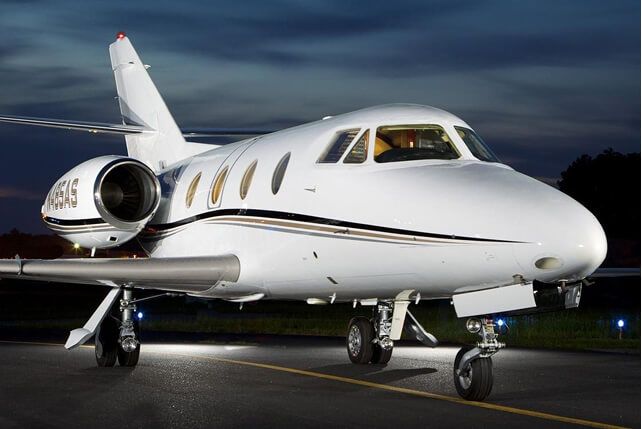
External Rear Baggage Compartment
Passenger Comfort & Experience
The Falcon 100 addressed a major logistical constraint of its predecessor by introducing a dedicated, larger, external rear baggage compartment alongside the existing nose bay. This structural modification was a crucial upgrade in enhancing passenger utility. By separating the baggage volume into two primary areas, the total usable cargo capacity was significantly increased (up to 74 cubic feet combined). More importantly, the external compartment offers much easier accessibility for ground crew, making loading and unloading more efficient. This ample, distributed baggage capacity means more passengers can bring full-size luggage and essential equipment on their missions without compromising on payload or range, maximizing the jet's utility for both corporate and personal travel. Furthermore, the increased Maximum Takeoff Weight (MTOW) complements this upgrade by providing the capability to carry this greater load.
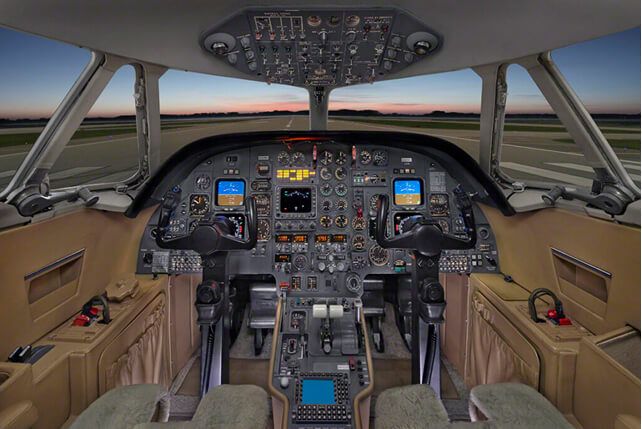
Digital Safety Assurance: First-Generation EFIS Cockpit
Safety & Operational Advantage
The Falcon 100 holds a unique place in aviation history as the first certified business aircraft to offer an Electronic Flight Instrument System (EFIS) with color screens as an optional upgrade. This technological leap replaced complex analog gauges with sophisticated digital display screens, drastically improving the flight crew's situational awareness, navigation precision, and flight safety. For the discerning charter client, choosing the Falcon 100 signifies a commitment to operating with the highest level of system integrity available in its generation. The digital display reduces pilot workload and clutter, allowing the crew to focus entirely on precision flight, offering superior assurance and reliability compared to the mechanical, analog cockpits of the older Falcon 10. This modernization is key to ensuring a safer, more predictable, and more reliable flight experience across all flight phases, especially during complex approaches.
Alternative Jet Options
Aircraft
Falcon 10
Super midsize jet
Flying in a Falcon 10
The Falcon 10, born from fighter-jet expertise, offers a high-speed, agile flight. Experience the ultimate in French executive design and performance.
Learjet 40
Super midsize jet
Flying in a Learjet 40
The Learjet 40 combines a surprisingly spacious, midsize-feel cabin with high-speed performance. Experience a smooth, efficient flight above the weather.
Learjet 45
Super midsize jet
Flying in a Learjet 45
The Learjet 45 redefines its class with a revolutionary, spacious cabin design. It combines midsize luxury and double-club seating with the legendary smooth ride of a high-performance executive jet.